
Chapter Text
Prologue
The Genesis Manuscript
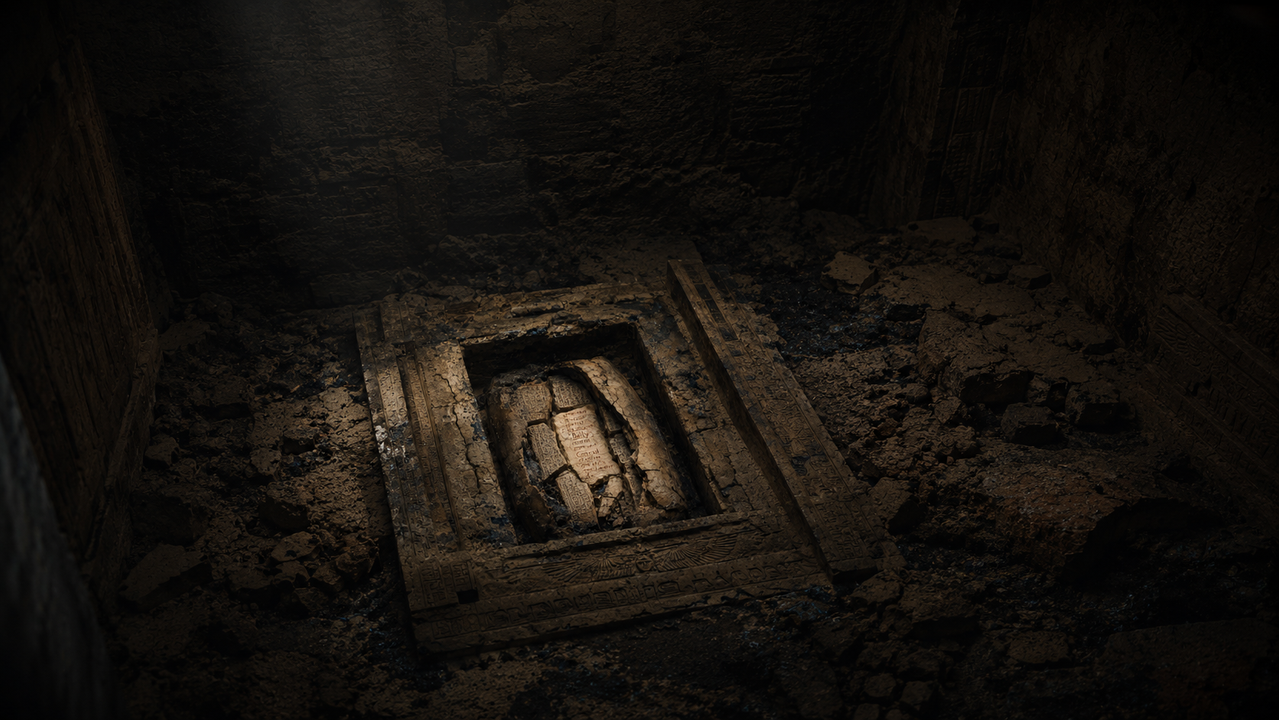
[Photograph taken at the southern boundary of the temple precinct. Restricted access.]
Dear Committee for Celestial Attachments,
We are pleased to present a preliminary archival memorandum on the newly recovered Genesis Manuscript.
I. As to Circulation and Mandatory Secrecy
Please note that the present fragments remain under restricted circulation within the National Military Museum.
Public access may be granted only after scrupulous examination and presidential approval.
Likewise, the recovered relic is currently pending final classification. Therefore, a nondisclosure agreement is required of every reader.
Acceptance is mandatory before moving forward.
We count on your absolute secrecy.
II. As to Scope of the Present Memorandum
The Committee is advised that the present memorandum concerns only the primary material recovered from the sealed chamber: the Genesis Manuscript and its associated fragments.
For the sake of procedural transparency, we must disclose that a secondary object was recovered at the same site. However, all documentation concerning this other object has been removed from the present memorandum and sealed under national security protocol by order of a higher authority.
The principal reason given for withholding the remaining evidence will remain classified until further notice.
Further disclosure will remain suspended until temporal, biological, and civil-security risks have been ruled out.
III. As to Material Denomination
For your clarification, the following document contains translated fragments of an unidentified celestial manuscript recovered during the third excavation season at the southern boundary of the temple precinct.
It is important to note that, strictly speaking, the material consists of a damaged astral-liturgical tablet assemblage, preserved in clay and sealed beneath funerary architecture.
However, this memorandum will keep the term “Manuscript,” first, as a matter of democratic clarity owed to the nation, and secondly because the source appears throughout the fragments as an account meant to be read, opened, and restored.
Then, that is settled.
IV. As to Recovery
That being said, we clarify that the Manuscript was originally located inside a sealed burial chamber beneath a collapsed stratum of fired brick, ash, bitumen, and blue-black mineral residue.
After close study, our findings indicate that paleographic dating places the material between the late third and early second millennium B.C.E.; however, the precise internal chronology remains unstable.
As to geography, the chamber lies inside a previously mapped section of the complex, less than nine meters from a corridor excavated during the first season.
Strangely, every prior survey, ground scan, and architectural report passed over the sealed recess.
For that reason, the omission remains difficult to explain.
In addition, we must state that the clay envelope surrounding the fragments appears to have fractured from within.
By force.
In that vein, our examination suggests that the break is fairly recent; however, a natural cause remains unconfirmed and under inspection.
V. As to the Fysh Summons
At the outset, the recess was located only after Dr. Bela Fysh, senior epigrapher on the translation team, reported a recurring dream involving a fixed point within the southern wall.
Importantly, her private notes reject the term “vision” alone, describing the sleeping visualization through a single repeated term instead:
“Summons.”
And, more precisely:
“A summons raised by a golden scepter, through a voice ruling the numbers.”
Allegedly, she woke with a pen and paper beside her bed, writing it down.
Although the Committee has advised against treating this as material evidence, the note is included here because the coordinates proved exact.
VI. As to Voice and Divine Offices
The account is governed by a dominant voice: first-person, ceremonial, and unmistakably feminine.
The figure treated by the source as divine calls herself Ishtar repeatedly.
A second presence, manifestly masculine, moves through the fragments under the name Shamash.
The Manuscript treats both as offices of heaven:
her, astral, martial, erotic, and sovereign;
him, solar, judicial, devotional, fertile, watchful, and severe.
Nevertheless, the precise nature of their relationship remains under heated academic dispute.
Classifications arising from our analysis include: “devotional hymn,” “astral myth,” “royal allegory,” “divine confession,” “liturgical drama,” “private love text,” or “post-temple prophecy.”
Despite our efforts, all classifications have proven insufficient.
The two figures, however, repeatedly identify their shared origin as “Genesis Flames.”
VII. As to Reclamation
Unlike other surrounding temple material, the current source — the Genesis Manuscript — appears particularly interested in correcting a myth while dismissing preserved ones.
What supports this argument follows: several damaged passages accuse human storytellers, priests, kings, and translators of reducing the so-called Genesis Flames into stories made “safer,” “smaller,” or “fit for worship.”
Therefore, the Genesis Manuscript’s language suggests an inner commitment to what one translator cautiously described as “global awakening.”
Similarly, several fragments move toward reclamation rather than record.
One recovered translation, attributed by context to Ishtar, reads:
They painted our ruin in gentler colors.
A second line, marked by solar-judicial imagery and tentatively attributed to Shamash, follows in partial form:
A lie was taken in the name of devotion.
Beneath both lines, the script steadies.
A shared sentence survives:
The truth may return when fragile beings have forgotten fear.
For this reason, several members of the translation team have suggested that the account may be a story personally permitted by Ishtar and Shamash.
The motivation behind such revelation, however, remains under study.
VIII. As to Kinship and Celestial Resemblance
A clarification of denomination has proven necessary, given the severity of the disputes surrounding origin, kinship, and celestial resemblance.
As highlighted above, the duo insist on describing themselves as flames born from one source.
In that light, several lines refer to Ishtar and Shamash as “twins,” though the term is almost certainly unstable.
Earlier drafts suggested “same-born,” “equal-flamed,” or “struck from one fire” as possible alternatives; accordingly, the Committee has retained “twins” only where the damaged source material leaves the fewest viable options.
The term should therefore be understood as astral likeness rather than biological kinship.
The text rejects the biological reading.
Violently.
IX. As to Burial and Permission
Even so, a further irregularity remains unresolved as of now.
Beyond that, the source repeatedly presents its burial as voluntary.
Persistently.
Indeed, the language speaks of restraint, postponement, and permission.
The account appears withheld by intention rather than concealed by priesthood, seized by enemies, or preserved by accident.
One damaged line has been translated, provisionally, as:
When softer bodies survive the cardinal hunger that once tore the powers of heaven apart, open me.
Conversely, the Committee has requested further review of this passage, although every alternate rendering has proven equally disturbing.
A warning has proven prudent.
During translation, multiple researchers reported unusual distress while handling the fragments, including recurring dreams, emotional disorientation, involuntary weeping, and the persistent impression that the tablet-set described an ancient love story by remembering one.
For this reason, readers are strongly advised to proceed with caution.
X. As to Prophecy
The final fragment has been placed here against the recommendation of two senior members of the translation team.
Its classification remains uncertain; however, “prophecy” is the closest available term.
The passage claims that the first fire would outlive the collapse of its own cult.
It would return long after the temples fell, and long after Ishtar and Shamash became names handled by scholars instead of prayers.
The surviving lines read:
Beyond the temple.
By the sea.
In the yellow season, when the days burn gold.
A dwelling raised on sand.
A jewel bound at the throat.
A pact carved into eternity.
Below these lines, in red script — the only marked color in the recovered material — two mortal names appear without divine marking, ritual prefix, or visible scribal correction:
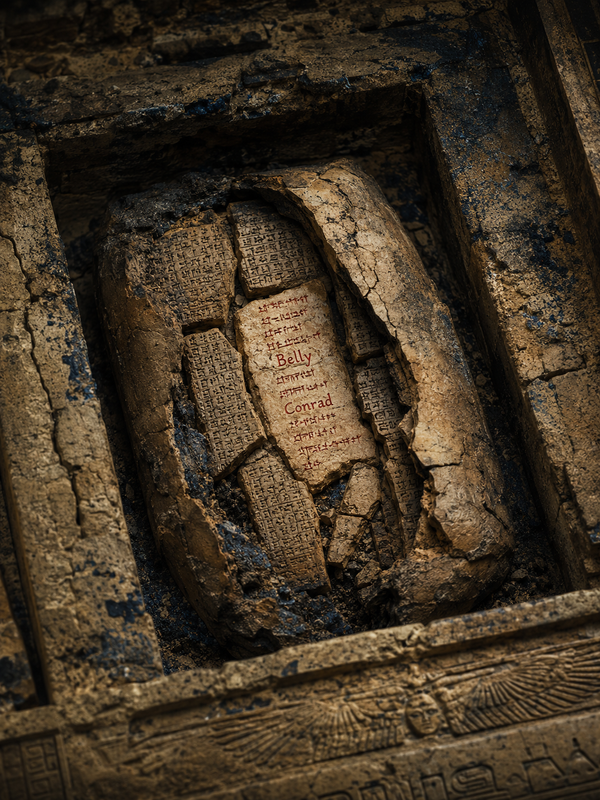
[Primary fragment, prophetic section. Red markings preserved.]
Belly.
Conrad.
Earthborn sparks.
Below the two names, several descriptive marks survive in a more fractured state.
The first name, Belly, has resisted formal expansion. One marginal note suggests an intimate diminutive rather than a ceremonial name; another connects the sound to oath, body, and beloved center. No conclusion has been reached.
Associated fragments describe her as follows:
Sweet breathing flame of two shores.
Star-cut sight, shaped by the far dawn.
Dark river behind her, falling in straight lines.
One aurora-bright curve kindled her countenance; his severe light bent.
The second name, Conrad, appears more stable. A tentative etymological note renders it as “bold counsel,” although the translation team has marked this correspondence as possibly coincidental.
Associated fragments describe him as follows:
Closed forest behind the gaze, timber-dark judgment.
Water-taught, upright above the rough sea.
Gold-tinted flesh trained for light.
His salt-wet strands spilled over flesh, before which her star faltered.
Supporting teams are currently examining the possible existence of living persons historically compatible with these names and descriptions for compliance and security purposes.
According to the Genesis Manuscript, the story would one day be carried across the world in a “softer” shape, although it would be mistaken for young love by those who failed to recognize the oldest divine tragedy in translation.
A secondary marginal element has proven relevant.
During careful inspection, several marginal lines suggest that the “lighter” form would not be endangered by hatred, but by proximity: one as-yet nameless beloved of house-blood appears repeatedly at the threshold of union, a second claim wedged between the jewel and the vow.
The identification, however, remains withheld pending further review.
In contrast, according to our working translation, although the wording remains unstable, the source does not name the betrayal as enmity, but as “competing devotion” drawn toward the Venusian beauty.
Our senior translation lead has emphasized the need to disclose certain alarming threats embedded in the prophecy: a very particular passage highlights a fevered enchantment capable of capturing the minds of crowds permanently, even through the youngest and most domesticated version of the tragedy.
One line, signed by Shamash, states:
Our frequency cuts the air into alpha waves.
Another, attributed to Ishtar, reads:
Once fate is sealed in vow, our song will be revealed.
The middle of the saying appears to be missing. However, the final portion has been rendered as follows:
A serene melody devouring ephemeral hearts beneath the appearance of peace.
The text then alleges direct divine intervention:
Let each be granted discernment: to know the harmful from the holy.
After internal discussion, we have reached a decision regarding the disclosure of the final warning, underlined in the source and bearing direct public-health relevance.
Therefore, the Manuscript states that the original history, once consumed, may cause severe and irreversible collective mania.
Despite all findings, the Committee has marked this section as unreliable.
The text, however, marks it as inevitable.
XI. As to Recommended Conduct
The Committee advises restraint.
During the reading of this Manuscript, and for as long as the present work remains incomplete, all authorized readers are advised to observe the following precautions.
All information concerning Ishtar, Shamash, and the Genesis Flames shall be received through this memorandum and its authorized fragments only.
Independent research, private reconstruction, astronomical comparison, or attempts to identify living counterparts are strongly discouraged.
Recognition prior to containment remains a documented risk.
Do not read the names as summons.
Do not seek the earthborn sparks.
Do not interact with suspected adolescent or young-adult manifestations of divine offices.
Do not look directly at the sun.
Do not point at Venus.
Do not count the lights surrounding Venus, should additional lights appear.
Do not attempt to determine whether Venus has moved closer.
Do not interpret unusual brightness, sudden heat, altered shadow, ringing silence, gold glare, sea-reflection, or private celestial coincidence as personal permission.
Participating observatories, civilian astronomical partners, and orbital monitoring teams have been instructed to report any large-scale irregularity involving solar behavior, Venusian brightness, unexplained eclipse formation, coastal light distortion, or synchronized atmospheric shimmer.
Even so, the Committee acknowledges that certain phenomena may occur on an individual observational basis and remain invisible to ordinary instruments.
If, during or after exposure to the Genesis Manuscript, any reader observes an unlisted eclipse, a second dawn, a star appearing beside Venus, a shadow moving against the sun, a gold mark on water, or any celestial event that appears to recognize them personally, such occurrence must be reported in the comment section below for archival comparison.
Reports should include time, location, object observed, emotional disturbance, and whether the anomaly appeared solar, Venusian, marine, devotional, or otherwise difficult to classify.
Do not romanticize the anomaly.
Do not assume the sky is speaking to you and do not assume it is not.
The Committee reminds all readers that the comment section is not a confession chamber.
It is, however, the only available field log.
Above all, do not mistake visibility for safety.
Shamash is a god of sight.
Ishtar is a goddess of appearing.
The fact that something can be seen does not mean it should be answered.
The flame remains flame.
XII. As to Editorial Determination on Names
Because the final prophecy supplies the only two mortal names preserved free of ritual distortion, this edition will use them where the account becomes intimate, personal, or narratively reconstructed.
The divine names, however, will remain where the source speaks in ritual, prophecy, or inscription.
This decision remains controversial.
Even so, it is also the only one that made the account readable.
XIII. As to Current Determination
Taken together, the recent fracture, the exact coordinates, the source’s corrective language, the classified secondary object, and the Manuscript’s repeated insistence on permission have led to considerable disagreement among the team.
Therefore, the official position remains that the Manuscript was discovered.
Several private logs, however, use another verb.
“Allowed.”
XIV. As to Continuity
A significant portion of the material remains illegible, unfortunately, as translators continue to work day and night for updates.
As soon as further fragments become available, we are committed to sharing them with you.
Each new fragment will be carefully audited and arranged for intelligible reading in the format of chapters.
We intend to have a fuller picture by the end of the current research, more accurately understood as a pre-romance mission.
We aim to assemble the material as puzzle pieces, while the secondary object, if proven safe, may be revealed before the very end.
XV. As to Living Status and Future Addenda
This memorandum should be treated as a living document and, for operational purposes, the central brain of the present investigation.
As additional fragments become legible, as classifications change, or as withheld material becomes safe for restricted circulation, the Committee may update the present file accordingly.
Any future correction, clarification, reversal, or newly authorized disclosure will be added at the end of this document under dated addenda.
Readers are advised that the absence of an answer in the present version should not be mistaken for the absence of evidence.
It may only indicate that the evidence remains asleep.
For now, what follows are the last presently legible lines of the Manuscript:
The birthmark.
The birthplace.
The genesis.
The end.
—
In secrecy,
Yours in flame,
The Chair
Committee for Celestial Attachments
Higher Lovers Division